
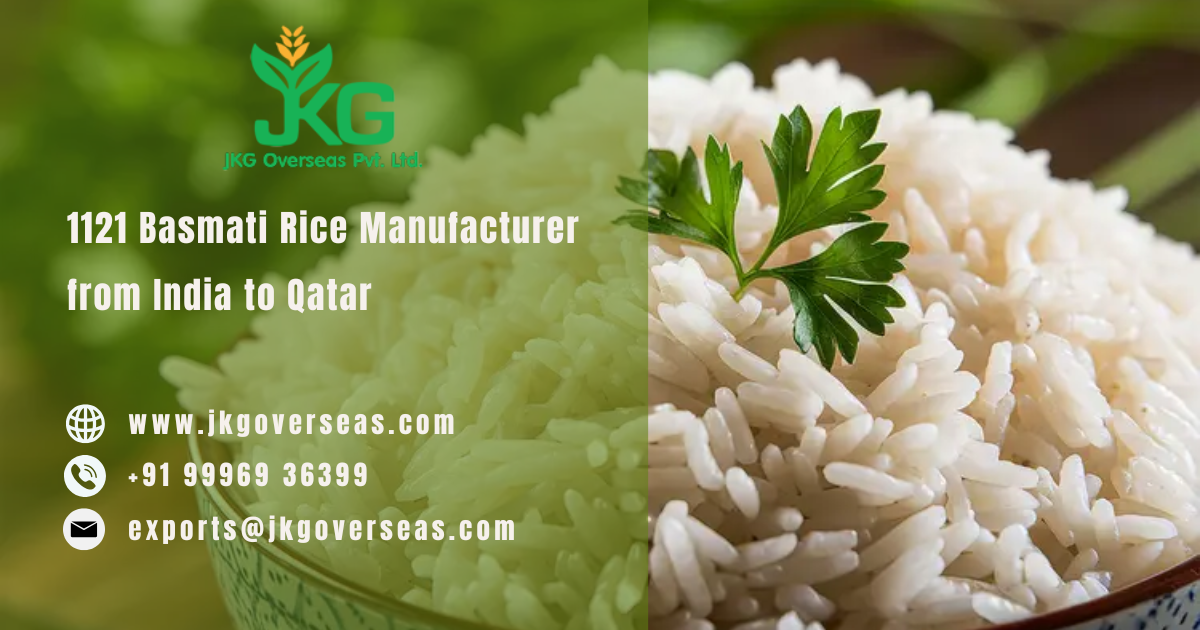
1121 Basmati Rice Manufacturer from India to Qatar
Walk through any spice market in Doha and you'll find 1121 basmati sitting front and centre — the long, slender grain that Qatari households and restaurants have come to expect. It's the variety that defines premium basmati across the Gulf, and Qatar imports nearly all of it from India. For a distributor or hospitality buyer sourcing directly, finding a dependable 1121 Basmati Rice Manufacturer from India to Qatar is less about picking a name off a directory and more about checking who actually controls the process from paddy to container.
JKG Overseas Private Limited has been milling and exporting rice since 1998 from Karnal, Haryana, one of the main basmati-growing belts in northern India. This article covers what makes 1121 basmati distinct, what buyers in Qatar should verify before ordering, and where a supplier's wider export experience actually matters.
What Sets 1121 Basmati Apart
1121 is prized for its grain length — often extending to around 8mm after cooking, nearly double its raw size — along with a distinctive aroma and a fluffy, non-sticky texture. Restaurants use it for biryani and pilaf precisely because the grains stay separate and don't clump. It costs more than standard basmati varieties, which means Qatari buyers are particularly sensitive to consistency; paying a premium price for grain that doesn't match the sample is a common complaint in the trade.
Ageing also plays a role. Basmati improves with age up to a point, developing a stronger aroma and better cooking behaviour. Mills that age their stock properly, rather than shipping fresh-milled rice to cut turnaround time, tend to deliver a more reliable product.
Choosing a 1121 Basmati Rice Manufacturer from India to Qatar
Ownership of the Milling Process
A manufacturer that mills its own paddy has far more control over sorting and grading than one buying pre-milled rice from third parties and repackaging it. JKG Overseas runs its operations as an integrated producer — sourcing, milling, and packing under one roof — which matters when a Qatari buyer needs the same grain specification shipment after shipment.
Handling and Packaging for Gulf Shipping Routes
Doha's Hamad Port receives regular container traffic from Indian ports, and the sea crossing is short by international standards. Even so, rice needs packaging that protects it from moisture and rough handling in transit — PP or jute bags for bulk buyers, vacuum-sealed retail packs for supermarket shelves, and private-label packing for distributors building their own brand. A supplier offering all three formats saves a buyer from arranging repacking locally.
Documentation That Matches Qatari Customs Requirements
Qatar's food import rules require clean certification: phytosanitary certificates, fumigation records, and lab reports confirming grain length and purity match the invoice. This is routine paperwork for an established Basmati Rice Exporter in India, but it trips up smaller or unregistered traders more often than buyers expect.
A Track Record Beyond Qatar
Some buyers worry that a supplier focused heavily on one destination might struggle with volume or urgency. In practice, it tends to work the other way. JKG Overseas's role as a Basmati Rice Exporter from India to Qatar sits alongside regular shipments as a Basmati Rice Exporter from India to Lebanon and other markets across the Gulf and Middle East, which keeps production running at a steady pace rather than in short bursts tied to one country's demand cycle.
That breadth also reflects in how the company positions itself more broadly — as a Rice Miller Exporter in India and Rice Miller Manufacturer in India handling both basmati and non-basmati grades, giving Qatari buyers room to add other rice varieties to an order without sourcing from a second supplier.
Questions Worth Asking Before You Order
- Request a current sample batch, not an old catalogue photo — grain length and colour shift between harvests.
- Ask how long the rice has been aged before milling and shipping.
- Confirm moisture testing happens pre-loading, and ask to see the report.
- Clarify Incoterms early — FOB versus CIF changes who's responsible for what during transit.
- Establish in writing how quality disputes get resolved if a shipment doesn't match the agreed spec.
These aren't exciting questions, but skipping them is usually how a buyer ends up stuck with a container they can't sell at the price they quoted.
Conclusion
Sourcing 1121 basmati for Qatar comes down to fundamentals: a manufacturer with control over its own milling, packaging suited to the shipping route, and export paperwork that clears customs without delay. JKG Overseas Private Limited history since 1998, its integrated operations in Haryana, and its established presence supplying Qatar and Lebanon give it the kind of operational track record that Qatari importers should be looking for in a long-term partner rather than a one-off supplier.
FAQs
Q: Why is 1121 basmati priced higher than other basmati varieties?
A: Its extra-long grain, extended cooking elongation, and stronger aroma set it apart, and the crop yield per hectare is typically lower than standard basmati, which pushes the price up.
Q: How is 1121 basmati typically shipped to Qatar?
A: Mostly by sea container through Hamad Port, either in bulk bags for wholesale buyers or retail-ready packs for supermarkets and distributors.
Q: Can a Qatari distributor request private-label packaging?
A: Yes — most established Indian exporters, JKG Overseas included, offer bulk private-label options so buyers can sell under their own brand name.
Q: Does the same exporter typically supply other countries in the region?
A: Often, yes. Suppliers exporting to Qatar frequently also ship to Lebanon and other Gulf markets, which tends to mean steadier production and more consistent pricing.


